
Redefining Online Learning: How GWUOHS Student Taha is Tackling Student Burnout
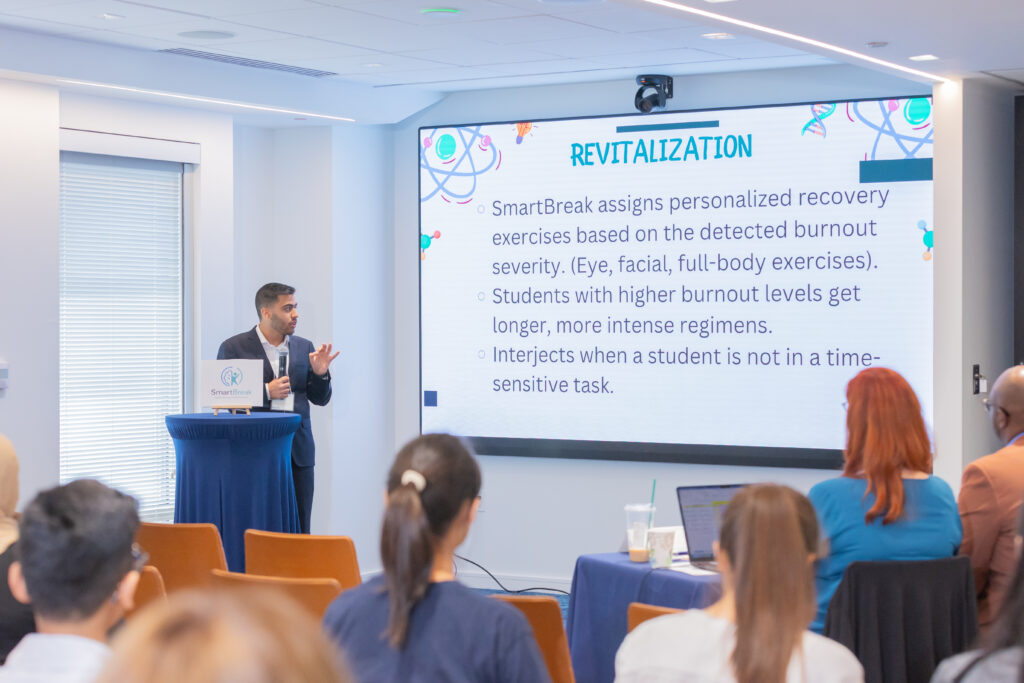
For many students, online learning offers flexibility and opportunity, but for George Washington University Online High School sophomore Taha, it also sparked a bigger question: how can students stay productive without sacrificing their well-being?
That question ultimately led Taha to become a finalist in the K12 Innovation Challenge, where he developed an ambitious idea aimed at helping students combat burnout before it starts.
Taha’s project, called SmartBreak, is an AI-powered study tool designed to recognize signs of fatigue in real time and provide personalized break routines to help students recharge and refocus. Rather than encouraging students to simply work harder, his idea centers on working smarter through balance, self-awareness, and prevention.
“Burnout is a problem across many fields,” Taha explained. “I didn’t think there was an adequate solution because most approaches only focus on recovery after someone is already overwhelmed.”
His concept uses technology in a thoughtful and practical way. By analyzing facial expressions and body language during study sessions, SmartBreak would detect signs of mental fatigue and recommend restorative activities before burnout escalates.
“It’s about preventative measures,” he said. “Helping students before they reach that point.”
Taha’s innovative thinking reflects both his passion for technology and his deep understanding of the student experience. As a 10th-grade student, he has experienced several forms of education throughout his academic journey, including public school, homeschooling, and online learning.
Before enrolling at GWUOHS, Taha often felt limited by the pace of traditional classrooms.
“In public school, everyone learned at a common pace, and that was too slow for me,” he shared. “I wanted a platform where I could learn at the pace that was best for me.”
While homeschooling offered more flexibility, he found that it lacked some of the academic resources and opportunities he was looking for. GWUOHS ultimately provided the balance he needed: rigorous academics combined with the freedom to personalize his learning experience.
“This school gives me both academic rigor and flexibility,” Taha said. “I can explore opportunities and learn new things in a way that works for me.”
Now in his second year at GWUOHS, Taha has taken advantage of the school’s wide range of courses and electives, particularly in science and technology. He especially enjoys the hands-on nature of his science classes and appreciates how the school creates engaging lab experiences in an online environment.
“He can simulate a real-life lab experience online,” he said. “I really like the hands-on experience.”
Taha has also explored programming through Java and C++ courses while continuing to develop interests that align with his future career goals. After graduation, he hopes to pursue a career in the medical field, with aspirations of attending The George Washington University.
“One of the biggest benefits of my time at GWUOHS has been the leadership opportunities I have been able to avail. Through organizations like the STEM Club and the GW Chronicle, I’ve been able to take on leadership roles. These positions have helped me meaningfully engage with the student body by organizing events. It has also enabled me to collaborate more deeply with faculty and staff.”
Outside of academics, Taha stays actively involved in his local community. He participates in youth discussions at his local mosque, where he helps facilitate conversations centered around religion and personal growth.
When reflecting on his favorite part of GWUOHS, Taha points to the dedication and support of his teachers.
“There were times I got stuck,” he explained. “But contacting my teachers always helped me overcome those obstacles.”
That supportive environment also encouraged him to take on challenges like the K12 Innovation Challenge. As part of the competition, Taha submitted a video presentation explaining his idea and later participated in a live judging session where he received valuable feedback from judges.
The experience strengthened both his confidence and his passion for solving real-world problems through innovation.
For students considering online school, Taha encourages them to think carefully about what type of learning environment will help them thrive.
“Find a pathway that can cater to your needs the most,” he advised. “Develop the interests you have for your career and professional development, and ask the school about pathways that interest you.”
Taha’s story is a reminder that online learning is not one-size-fits-all. With the right support, flexibility, and opportunities, students can pursue their passions, innovate boldly, and create meaningful solutions that impact others far beyond the classroom.